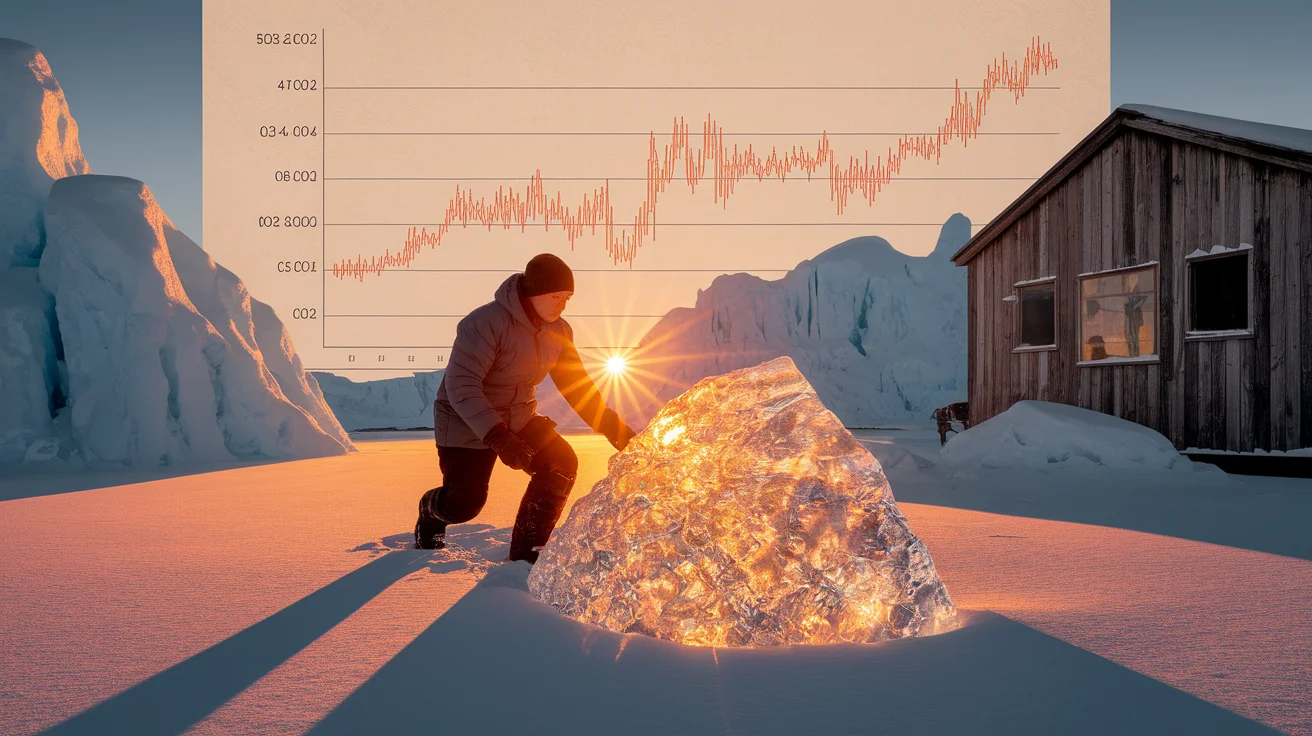
Researchers examined ice core samples from Antarctica, showing minimal changes in greenhouse gas concentrations across ancient climate periods.
Researchers from various institutions published a study in Nature on March 18, 2026, analyzing ice core records from Antarctica that span 3.1 to 0.5 million years ago. The study focuses on atmospheric levels of carbon dioxide (CO2) and methane (CH4), revealing no significant changes in mean CH4 and a small decline of about 20 ppm in CO2 between 2.9 and 1.2 million years ago.
The ice cores, drilled in the Allan Hills Blue Ice Area, provide snapshots of greenhouse gas variations. These records indicate stable CO2 concentrations of around 250 ppm during the early Pleistocene, with levels remaining within ±10 ppm across the mid-Pleistocene Transition.
Key Findings from the Ice Core Analysis
The study involved multiple authors, including Julia Marks-Peterson and Sarah Shackleton, who used discontinuous ice core samples to assess gas levels. They corrected for postdepositional processes, such as respiration, by using stable carbon isotopes in CO2 to ensure accurate measurements.
Samples from 2.8 to 3.1 million years ago showed CO2 levels indistinguishable from those in the early Pleistocene at 250 ± 10 ppm. The records highlight that these measurements represent averages over glacial cycles, influenced by climate-dependent accumulation rates.
Although the palaeoclimate archives from Antarctic blue ice areas are complex, the study extends greenhouse gas measurements back to the late Pliocene epoch. This period was marked by global cooling and falling sea levels, as documented in the research.
The findings are based on data from the Nature publication, emphasizing the role of ice cores in understanding Earth's climate history. The study includes contributions from experts like Jeffrey Severinghaus and Edward Brook, who helped compile the comprehensive records.
Overall, the research underscores the continuity of greenhouse gas levels over millions of years, providing a foundation for further climate studies based on the analyzed ice core data.