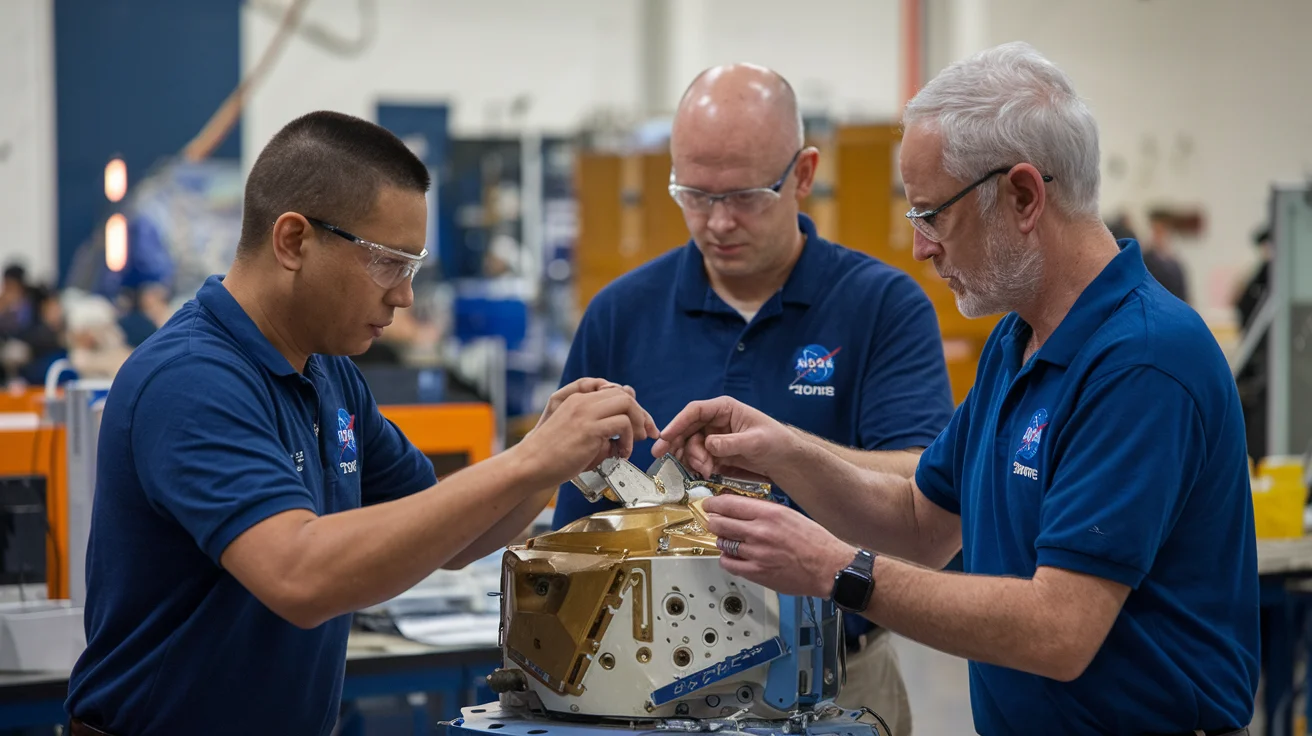
NASA advances risk assessment for spaceflight hardware by developing a method to evaluate the safety of reducing nondestructive evaluations.
NASA's Engineering and Safety Center (NESC) has developed a new method for estimating the risks associated with reducing nondestructive evaluation (NDE) on spaceflight hardware. This approach addresses concerns about the cost and schedule impacts of NDE while maintaining compliance with NASA's Technical Standard NASA-STD-5019A, which requires fracture control plans to ensure damage tolerance.
NDE involves inspecting for flaws in materials to prevent catastrophic failures. Under NASA-STD-5019A, these inspections verify that parts can withstand their service life, even assuming undetected damage exists.
The New Probabilistic Analysis Method
The NESC's method uses probabilistic analysis to calculate the probability of failure if NDE is reduced or eliminated. It incorporates factors such as the likelihood of flaws existing, the chance of missing them without NDE, and the potential for failure if undetected.
To demonstrate this framework, NESC analyzed a historical database of 33,630 bolt-hole inspections over three years, identifying six crack-like features. This data helped estimate a 95% upper confidence bound of 0.04% for the probability of a detectable flaw existing per inspection.
The analysis showed that reducing NDE could lead to a structural reliability of approximately 99.96%, or about 3.4 'nines,' based on conservative assumptions. Sensitivity studies indicated that larger sample sizes, such as 100,000 inspections, only marginally improve this to 3.5 nines.
Key assumptions include the need for time-invariant process controls to ensure historical data predicts future risks accurately. Data aggregation across similar parts requires qualitative and quantitative assessments of similitude, and the method must be part of a broader fracture control evaluation by NASA authorities.
For further details, contact Patrick E. Leser at NASA or refer to the technical memorandum NASA/TM-20250004074. This development could help NASA programs make informed decisions on NDE reductions without compromising safety.